LBO
A Guide to the LBO
In this article
Overview
This article will provide an overview of the fundamentals of leveraged buyouts (LBOs), including a definition, an explanation of the mechanics, and some detail on the nuances of the structure.
A leveraged buyout (LBO) is an acquisition where a company is acquired primarily through debt, while using the target company’s assets as collateral. This structure, most commonly used by financial sponsors (private equity firms), allows the acquirer to minimize their equity check to fund the acquisition, thereby enhancing their rate of return. Typically, the financial sponsor aims to exit the investment in 5–7 years, through the sale of the company or an IPO.
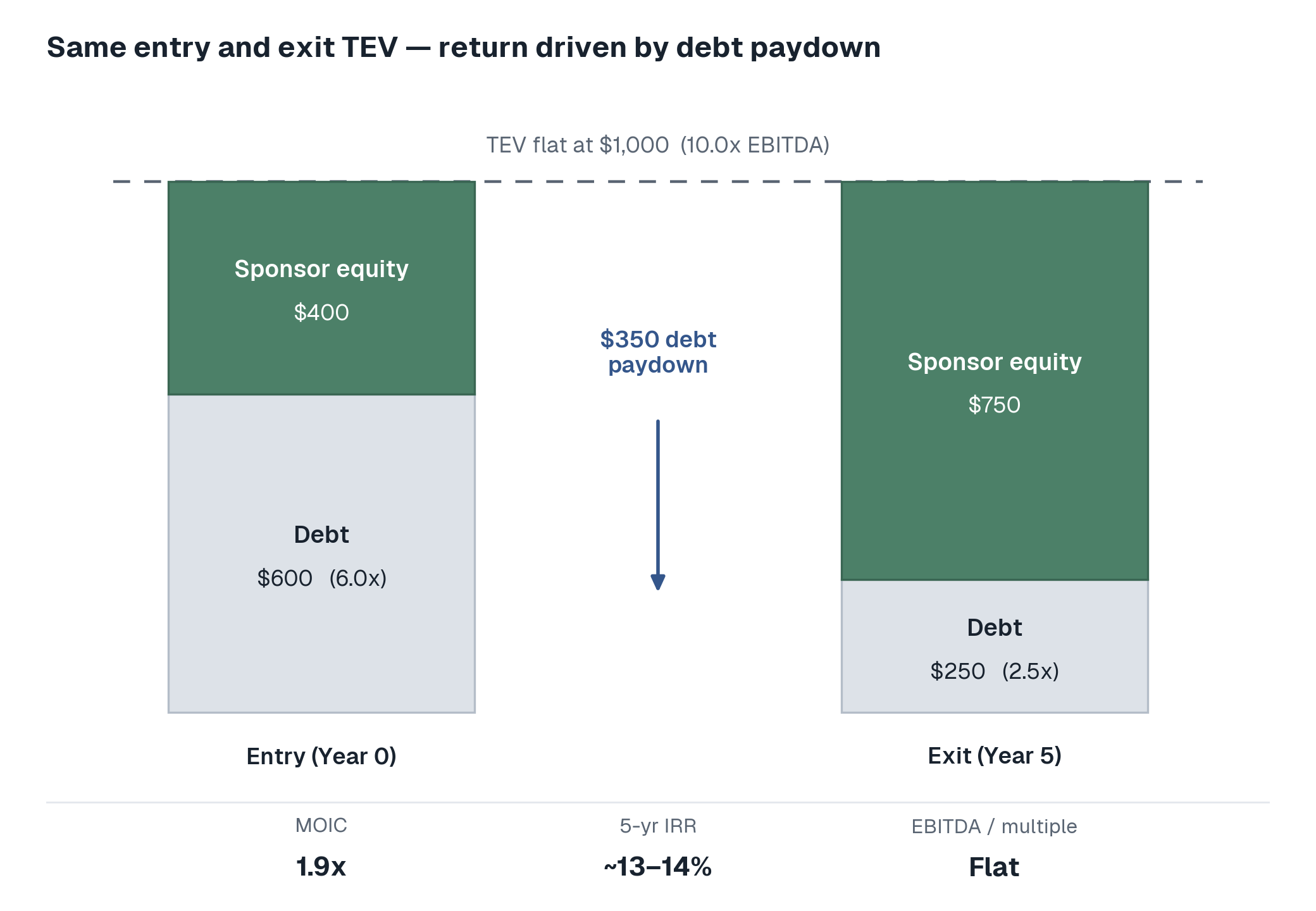
An LBO can provide attractive returns to an acquirer, typically higher than if the deal was funded by majority cash or stock. This is because by using borrowed funds to finance the acquisition, the financial sponsor minimizes their initial invested capital. Throughout the hold period, as the cash flows of the business are used to reduce the debt load, a larger percentage of the enterprise value of the company belongs to its equity holders. In fact, it is possible for a financial sponsor to sell the business at the same price it purchased it for and still earn an attractive return, because they own a larger portion of the TEV (see Exhibit 1). This lever to enhance returns in an LBO is called debt repayment, one of three key levers to increasing the returns in an LBO.
The next value lever is EBITDA growth. Through either revenue growth or margin expansion, if a financial sponsor increases the EBITDA of the business, they can thereby increase their exit price, enhancing their returns. Moreover, EBITDA growth almost always implies higher cash flow generation, meaning the sponsor is able to more aggressively pay down debt (the first lever of LBO returns).
Finally, a financial sponsor can enhance their LBO return through multiple expansion. If they can sell the business for a higher multiple than they acquired it for, they can earn a healthy return, even if they failed to execute on the first two levers. This lever is typically seen as the least trustworthy to underwrite, as it is heavily dependent on market conditions. A financial sponsor has control of debt repayment and EBITDA growth more than it does the exit multiple that the business will command in the market.
LBO Candidates
Now that we’ve defined an LBO and outlined the levers to enhance returns, let’s think about which businesses are the ideal targets for financial sponsors pursuing these types of transactions. The most important aspect when reviewing targets is to find a company with strong and predictable cash flows. Remember, to meet interest payments, the acquirer uses the cash flows of the target company to service the debt, making quarterly interest payments throughout the hold period. To avoid default, a sponsor must ensure that the company they are acquiring generates sufficient cash flow to service the debt. Additionally, financial sponsors usually have a view on what they can change in the business under their ownership to accelerate EBITDA growth. This can happen through cost rationalization or enhanced top-line growth.
Measuring Returns
How do investors actually measure returns in an LBO? Typically a financial sponsor will look at both MOIC (multiple on invested capital) and IRR (internal rate of return). These metrics help quantify the return on the initial equity investment.
MOIC measures the magnitude by which the initial equity investment has increased. For example, if the initial equity investment was $100mm, and the equity value of the business at exit is $300mm, this represents a 3x MOIC. The target MOIC of a typical financial sponsor is ~2.5x–3.5x.
While useful, this metric does not consider the time period for which the investment is held. For instance, if a financial sponsor exits an LBO after 1 year and earns a 3x MOIC, and another sponsor exits an LBO after 7 years and earns a 3x MOIC, this metric reflects those investments as equivalent. However, they are far from equivalent: if I offered you a chance to 3x your money over 1 year vs. over 7 years, you would obviously take the former.
This is where the other common metric, IRR, comes in. IRR measures the annualized compounded rate of return earned on a private equity firm’s invested capital. Let’s return to the prior example: if a financial sponsor receives a 3x MOIC in 1 year, this would represent a 200% IRR, and if they receive a 3x MOIC in 7 years, this would represent a ~17% IRR. IRR considers timing and rewards an earlier exit of the investment.
IRR can also pick up proceeds received by the financial sponsor prior to exit. Financial sponsors will sometimes perform a dividend recap, a special dividend in which the company takes on additional debt to pay a one-time dividend to its equity holders. If the business is performing well and can sustain more debt, financial sponsors will do this to enhance their return. Doing a dividend recap prior to exit means that the financial sponsor would receive proceeds back earlier than if they just sold the business at the end of their holding period. Therefore, this is beneficial to their IRR as it moves forward their realization of proceeds.
Next Steps
As with the DCF, the nuances of an LBO and all financial models are best understood in Excel, not with books or articles. First understand the concepts, but then play around in Excel with an LBO model, either a brief or detailed version. Once you have it set up, try changing assumptions and see how various levers affect the returns.